When pharmacists and general practitioners form a symbiosis
Oct. 2021Interprofessionality and coordinated care
Many family doctor practices in Chur have closed in recent years. Medi Porta has developed an interprofessional business model to counteract the impending shortage of primary care. Combining the resources of pharmacies and doctor’s practices allows tasks to be allocated sensibly and generates a wide-ranging service offering for the population.
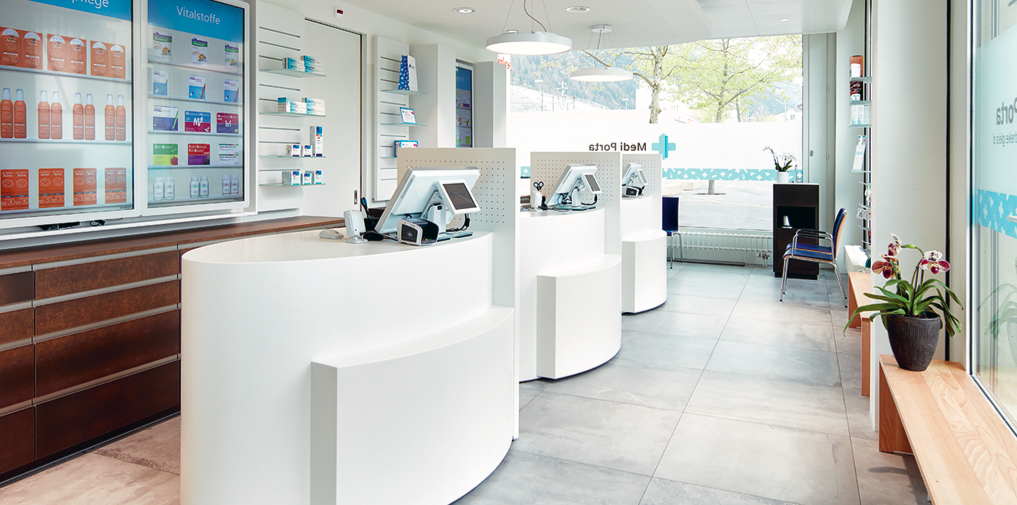
The gleis d (“platform d”) medical centre is right next to the station in Chur. Doctors have set up various practices on the top three floors. Nothing unusual there. The unusual feature is Medi Porta on the ground floor. This is an interprofessional advice and treatment centre – something that a biologist might well refer to as a symbiosis of pharmacy and family doctor practice. And something that, according to the Medi Porta website, “combines the advantages of a pharmacy with those of a doctor’s practice”.
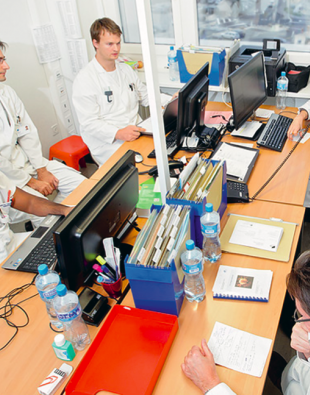
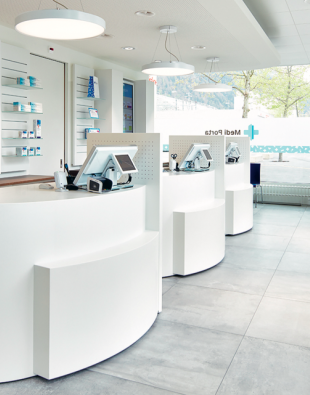
“We have found room for a retail area, workplaces for the pharmacists, two treatment rooms for general practitioners, a room for X-rays and a laboratory, all in the space of 170 square metres,” says Christoph Quack, the medical director of Medi Porta. Space constraints mean that the pharmacy’s medicines are stored in the basement; a robot automatically retrieves them as needed.
A shortage of primary medical care
The new business model was a matter of urgency, Quack says. Between 2008 and 2015 the number of consultations with general practitioners at the gleis d medical centre almost doubled. One of the main reasons for this was that many general medical practices closed in Chur when the doctors retired. In 2015, Grisomed, the doctors’ network in the canton of Graubünden, warned of an impending shortage of primary medical care. “We knew that we would be getting more patients – and that we could only provide care for a limited number of people with an additional practice,” Quack says.
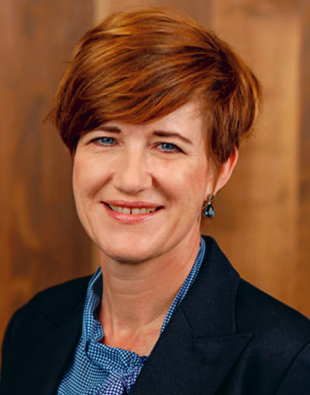
This gave rise to the idea of working with a pharmacy that would provide advice to people as their first point of contact, and triage them at the same time. “If somebody has cystitis, for example, we talk to them and use an established algorithm to find out whether we can dispense antibiotics straight away, or whether we need to refer that person to a doctor,” says Barbara Caratsch, a pharmacist and manager of Medi Porta. Caratsch says that many people are glad to be able to talk to a doctor about their problem right away. The two practices behind the pharmacy area have 30-minute appointments available every day that can be booked by Caratsch and her colleagues. She says that it is also advantageous for the pharmacists to be able to refer people immediately if needed. “When the person returns, I find out straight laway what was discussed with the doctor,” she says.
An enriching exchange
Quack also sees many advantages in this symbiosis. For example, “Since we’ve had our own medicine experts on hand, we haven’t had to talk to pharmaceutical sales reps.” Quack had initially hoped for even closer collaboration – he would have liked, for example, to discuss patients’ medication schedules with the pharmacists. “But unfortunately this didn’t turn out to be possible,” he says. In everyday practice, there is often simply not enough time to get together and talk.
Pharmacy assistants and the practice assistants do, however, engage in a lively exchange. The people working in the pharmacy benefit from insights into aspects of medicine such as the evaluation of blood results from the laboratory, or interpretation of heart activity recorded on ECGs, Quack explains. At the same time, the people working in the practice benefit from the proximity to the pharmacy, and a reciprocal understanding of the different philosophies has developed during the four years since Medi Porta was set up. “We see people as patients, the pharmacists see them as customers,” Quack says. He has found that approaching the patient as a customer also results in greater service orientation. “As a patient, it’s often complicated to get medicines delivered to your home from a doctor’s practice. But that’s the standard approach for a pharmacy,” he says.
This service orientation has also given rise to the low-threshold “advice at the customer’s level” which Medi Porta promises on its website and which focuses on the customer’s individual needs. As its name suggests, Medi Porta’s doors are open to everyone during business hours, even without an appointment.
The “platform d” medical centre seems to have made a virtue out of necessity. It offers a full range of care, from advice and diagnosis to treatment, in one place. “The close networking between pharmacy and medical practice allows us to allocate tasks more effectively – and people get exactly what they need at a particular moment in time,” Quack concludes.